
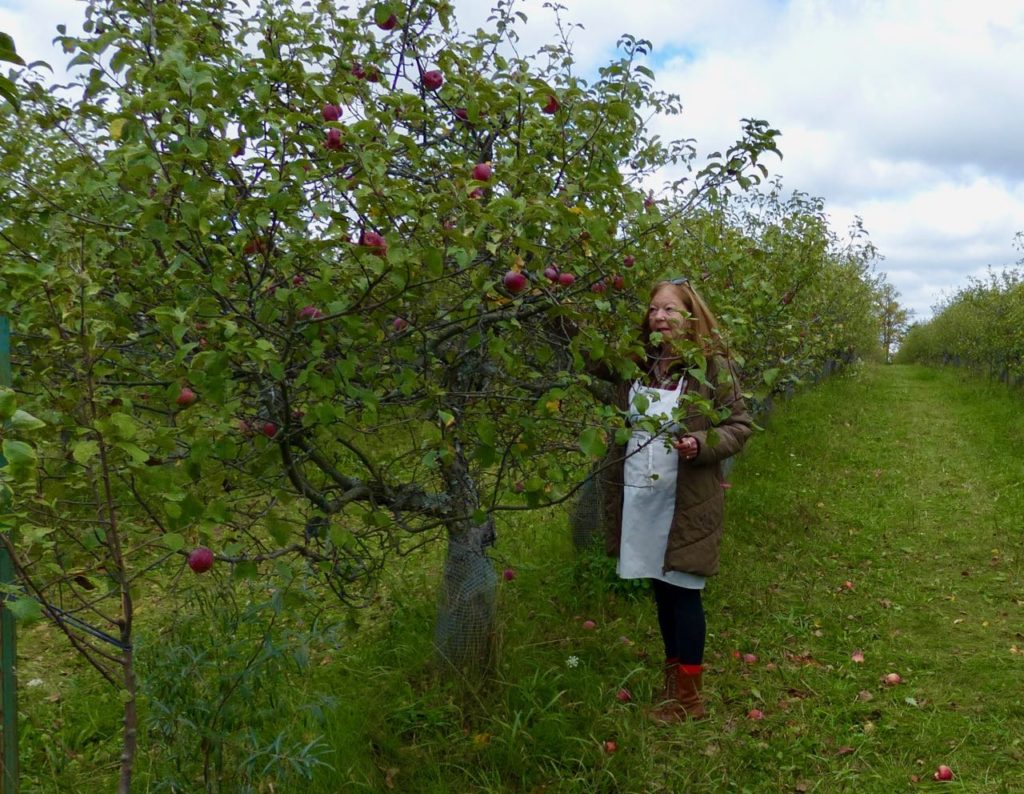
In the Ben Nobleman Park Community Orchard we have lots of fun caring for our fruit trees and pollinator garden. And each year we get to enjoy the harvest with delicious organic fruit including apricots, plums, cherries, and Asian pears.
But we rarely get to taste the apples that we grow. The problem is that park visitors harvest our fruit as they walk through the park. It’s easy to know when cherries and plums are ripe. But it’s harder to identify when apples are ripe if you aren’t familiar with the cultivar. So people harvest our apples before they are ripe. By harvest time in September and October, our trees are usually bare.
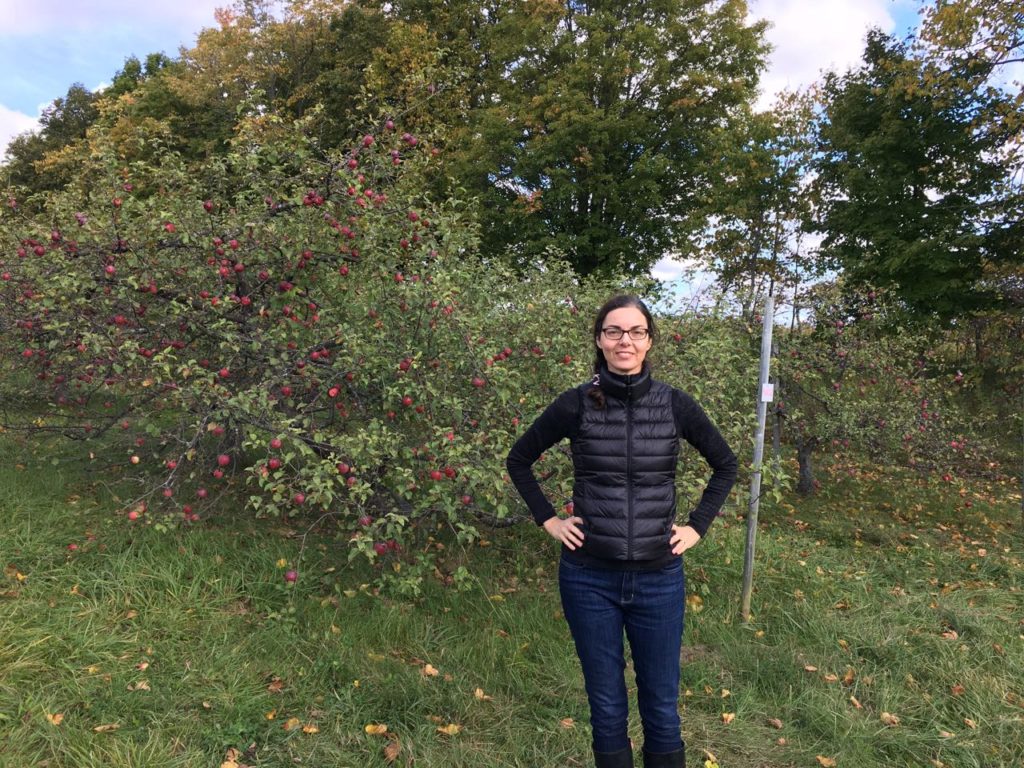
So I decided to take a trip up to Avalon Orchards in Innisfil, Ontario. Avalon Orchards is special because the owner, Gaye Trombley, focuses on growing disease resistant apple varieties. Many of these trees are the cultivars that we have in our community orchard.
There were three types of apples that are ripe and ready to eat, and so I called Lynn and Sherry and asked them to join me for an impromptu apple tasting where we can compare the flavour and the texture of the cultivars.
I had also gathered three different heirloom apples from an apple tasting the week before. So the three of us got together and tasted our way through apple history…and this is what we found.
Heirloom Apple Varieties: Snow, Macoun and Opalescent

We started off by tasting the oldest apple. The Snow apple (also known as Fameuse) can be traced back to France in the 1600s and a newcomer brought it to North America in the 1700s. This apple variety is called “Snow” because the flesh is very white and because the tree is hardy in colder climates. The fruit is small, but sweet and juicy. We loved it and felt we could taste a faint flavour of almond in it. Many believe Snow is an ancestor of the famous McIntosh apple. While now it’s harder to find, this variety was widely grown in Quebec in the 1700s and 1800s.
Then we moved on to Macoun. Developed by scientists at the New York State Agricultural Experiment Station in Geneva, New York, and introduced in 1923, Macoun is a cross between a McIntosh apple and a Jersey Black Apple. It may have inherited its colouring from the latter because it’s a lovely dark red with a purplish blush. It’s a pretty apple, but it didn’t excite us. It was sweet and crispy but not very juicy and tasted dry in our mouths.
Next up to bat was Opalescent. In the 1880s in Michigan, a man called George Hudson found a seedling apple tree that produced this tasty fruit. He decided to name it Hudson’s Pride of Michigan. Later on, the fruit would be propagated and marketed under the name Opalescent. To us, Opalescent tasted sweet but it wasn’t juicy and like Macoun if felt dry in our mouths. So of the three historic apples, all three of us favoured the oldest one. Snow has been a popular apple for centuries for a reason.
Modern Disease Resistant Apple Varieties
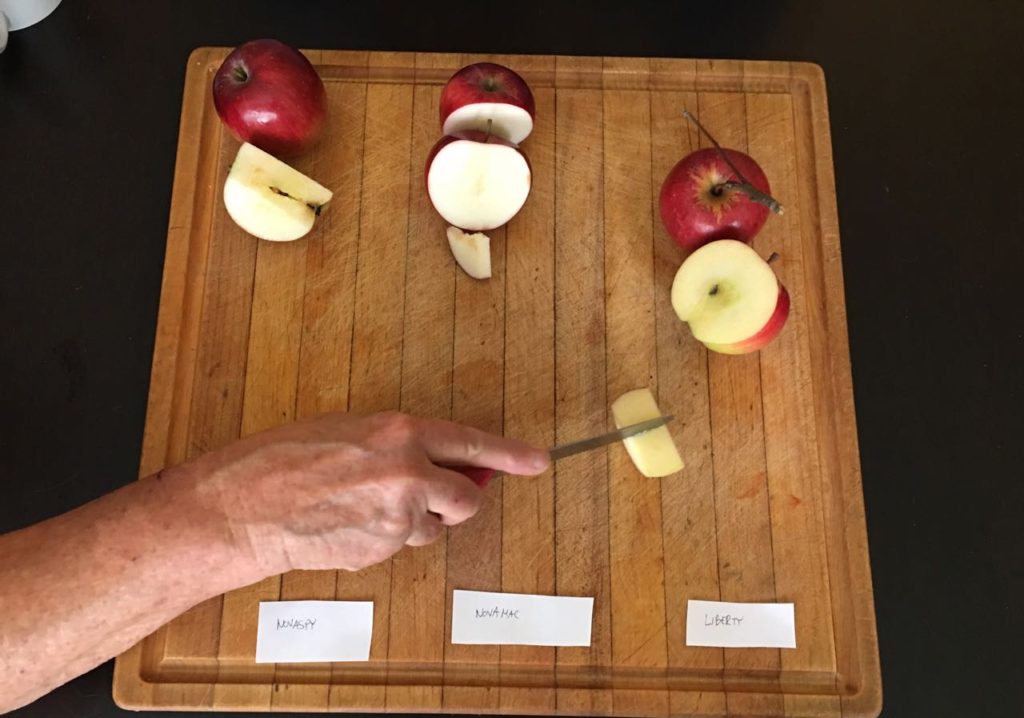
Now it was time to clear our palates and time travel to more recent times. Next we tasted three disease resistant apple varieties from Avalon Orchards and they included Novaspy, Novamac and Liberty. The first two varieties were developed at the Canadian Agriculture and Agri-Food research station in Kentville, Nova Scotia. Their goal was to create hybrid apple trees through cross pollination (not genetic modification). These trees are easier to grow because they are less vulnerable to common apple tree diseases.
Novaspy knocked our socks off. This apple, which has in its parentage Red Spy and Golden Delicious, was crispy and juicy. It’s an easy eating apple and would also be perfect with cheese or in baking. It’s sweet and tart (many say it’s sweeter than McIntosh and Spy apples) and is just a little astringent. This is a perfect apple for adults with a good sense of taste. Kids would like it to.
Novamac was good, but couldn’t stand up to the Novaspy in our books. It has McIntosh in its parentage but it’s said to have a firmer texture. And like McIntosh, it’s supposed to have a bit of a wine flavour to it. I’m not a big fan of McIntosh so for me Novamac wasn’t high on the list.
Then we tried Liberty. This is a bit of a “super apple variety” as it is resistant to so many different apple tree diseases. Scientists at the New York State Agricultural Experiment Station developed it in 1955 by hybridizing Macoun with another type of apple. They introduced Liberty to the market in 1978. It’s a good apple. Crunchy, tasty and sweet.
Gaye gave me one extra apple to taste as well. It was a Pristine apple and it was perfectly imperfect. Pristine apples ripen in August so Gaye had just one imperfect specimen left which we cut up and shared, working around the spotty parts. Pristine was developed by the PRI disease resistant apple breeding program in Indiana in 1994. It’s resistant to apple scab which is great. But it tastes FANTASTIC.
One bite is a taste of heaven. Pristine is sweet with no tartness and to us, it had a bit of a caramel flavour to it. This is a candy apple that doesn’t need to be covered with candy. We really enjoyed it and kids would love it too. So here are our favorites, in order:
- 1st Place: NovoSpy
- 2nd Place: Pristine
- 3rd Place: Snow
- 4th place: Liberty
There are Hundreds More Apple Cultivars To Explore
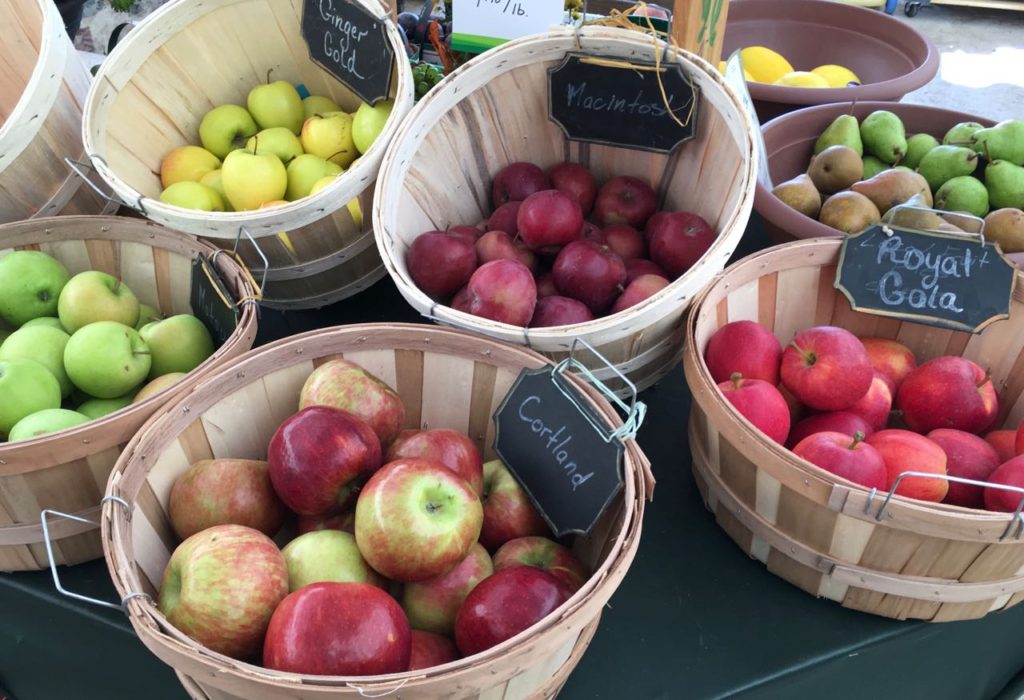
In today’s tasting session, we tasted 7 apples and 6 of them were red. And yet, if you looked closely, you could see differences. In some the inner flesh was bright white. In others the colour of the flesh was cream or greenish. Some had dark red skin with subtle stripes. Others had a red blush on a yellow or greenish background.
But when it comes to apples, there is so much diversity. Apples can be red, yellow, green and all sorts of shades in between. The flavours can be very different. In an event last weekend in Mississauga called “You are a Good Apple” there were over 40 heirloom cultivars to taste and each type of apple looked and tasted different. Visual artist Diane Borsato organized that event and we are proud to say that Diane and her son Felix are also volunteers in The Ben Nobleman Park Community Orchard.
So here’s a challenge for you: each autumn, why not make an effort to go apple picking at an orchard that offers many different cultivars for tasting?
My next apple tasting adventure will take place next weekend (October 12, 13 and 14) at O’Keefe Grange where orchardists Bill and Lyn O’Keefe grow over 500 cultivars of heirloom apple trees. Next weekend many of those varieties will be available for tasting and you can also buy and take home your own custom grafted apple tree. Hopefully I’ll see you there!
Susan Poizner is the coordinator of The Ben Nobleman Park Community Orchard in Toronto and the author of the award-winning fruit tree care book Growing Urban Orchards. Susan teaches fruit tree care skills online at he fruit tree care training website OrchardPeople.com. Susan is also the host of The Urban Forestry Radio Show and Podcast, a show that explores topics relating to fruit trees, food forests, permaculture and arboriculture. She is also an ISA Certified arborist.