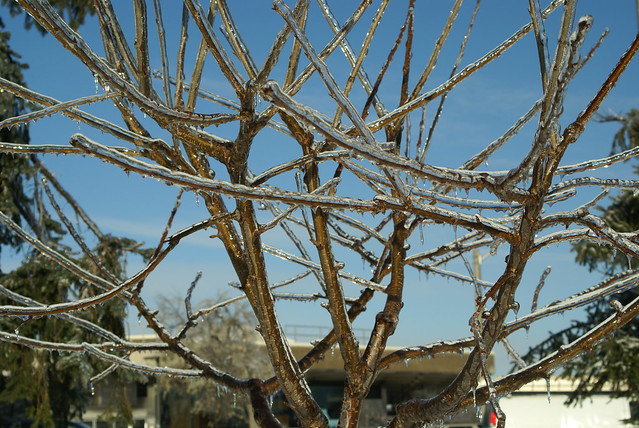
Norm Herbert Inspects our Orchard
Humans have been growing fruit trees for thousands of years. But did you know that today our fruit trees have more diseases than ever before? That makes it more challenging than before to grow fruit trees organically.
When you have a diseased tree, sometimes the only solution is to quickly remove it from the orchard so that the disease does not spread to neighbouring trees. Sadly, this is something we recently discovered first hand.
During our workshop on May 19 on Organic Pest Control, our teacher Norm Herbert showed us a clear blob oozing out of the slender trunk of one of our young plum trees (see picture below). Norm identified this as Canker, a deadly disease caused by fungus.
If the Canker was on a branch, perhaps we could have cut it off and saved the tree. But because it was on the trunk, it was too late. The tree would have to be removed. Norm told us that the disease was probably in the tree when we purchased it.
And so, just two days later, Lynn, Cliff and I (Susan) went out to the park to do the deed. We used a saw to cut it down. We also had to remove one of our cherry trees as it had somehow received a fatal gash on its trunk.
One suggestion to prevent spreading disease in your urban orchard: ALWAYS sterilize pruners before moving from one tree to the next, even if there is no evidence of disease. It will pay off to be cautious. And avoid pruning in the rain since wet conditions encourage the spread of disease.
The good news? There has to be some of that too. Norm is coming back this Sunday to teach us about how to choose a fruit tree for your yard (it’s not as simple as you’d think). And he’s bringing along two handpicked trees from Niagara that we can plant: one plum and one cherry. We will soon have 14 fruit trees again.
According to Norm, our little orchard is the perfect teaching tool specifically because we face all the challenges commonly found in urban conditions.
We look forward to seeing you all in our little orchard soon.
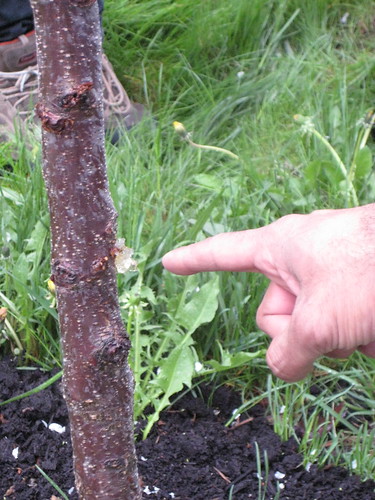
Goopy evidence of canker, a fungal-based disease on fruit trees